Her Pencil Stops. The Tablet Stays Closed.
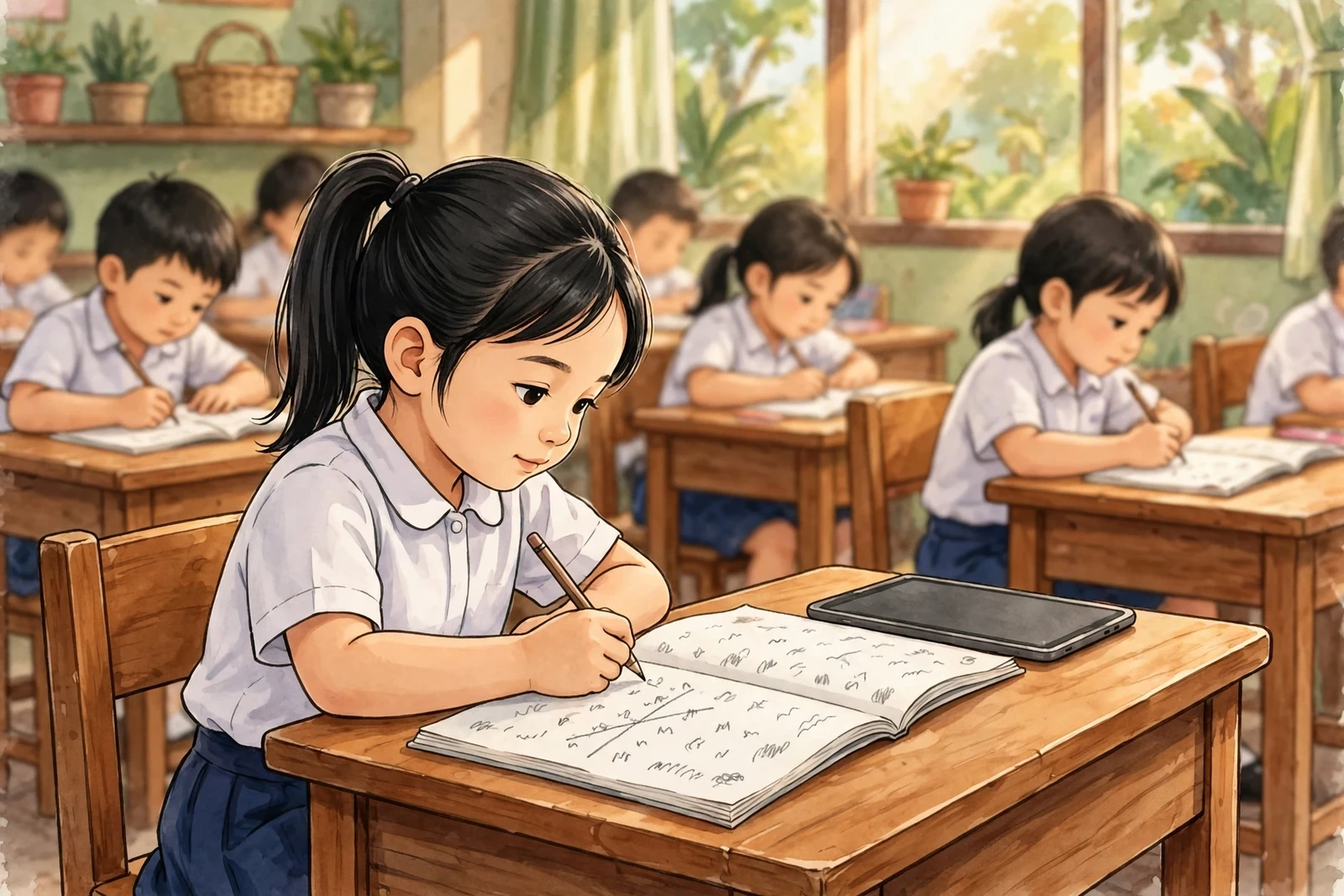
A P4 girl with a black ponytail writes her answer in a printed workbook. Her white school sleeve touches the page as her pencil stops.
She looks back at the sentence she has written. One word comes out. Another takes its place. The pencil starts again.
Beside the workbook, a tablet stays closed. Her teacher walks past and sees the crossed-out word, the new sentence, and the work between them.
Only after she has written her answer does she open Primary Advantage. She types the same sentence into the long-answer box and taps Get feedback.
The app now has something important to work with: her own words.
The first attempt belongs on paper
This order is Workbook-First Protocol, the fourth pillar of the Big 4 classroom-fidelity protocol. Its principle is rigorous writing practice before AI assistance.
Students complete workbook exercises on paper before they ask the AI for help. Teachers watch students write and keep the first attempt in the workbook. The AI serves the second pass: refine, get feedback, or get unblocked.
The classroom reason is simple. The productive struggle of writing by hand builds skill. A child who goes straight to the AI gives that struggle away.
Primary Advantage gives that struggle a fixed place in the lesson. The program provides foundation-building extensive reading for grades 3 to 6 English. Each printed workbook holds 14 lessons, and every lesson follows the same 13 printed steps.
Step 8 is Guided Response. Step 11 is Guided Writing. In Guided Writing, the child reads the prompt, plans, uses sentence frames, drafts, and checks her work.
For the teacher, the sequence gives a clear job: protect the plan and the draft. For the child, the page gives her somewhere to try, change her mind, and try again.
Feedback has a clear job
The app responds to the writing; it does not start it.
On the long-answer card, her sentence sits in the answer box. The line under the answer box reads Write at least 30 characters. · 2 tries left. The card shows two buttons below: Get feedback and Submit answer.
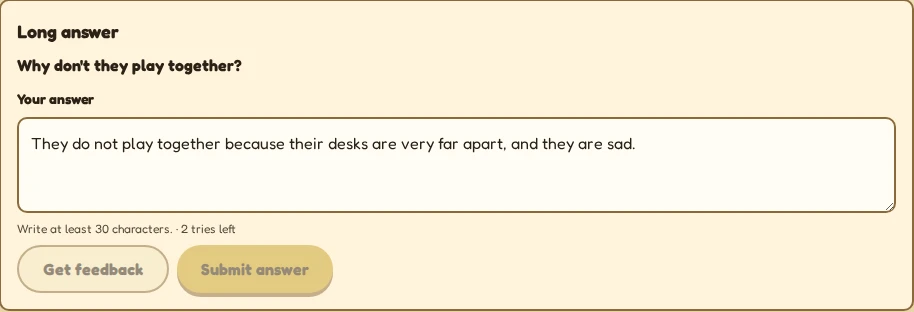
Primary Advantage gives this AI feedback on short and long written answers today.
She can use the feedback to look again at her sentence. The revision begins with an author who has already made choices. Her crossed-out word on paper is part of that work. The app's feedback gives her another view of what she wrote.
This is Blended Learning: printed workbooks plus the app. Each has a distinct job. The workbook contains the child's first attempt. The app responds to that attempt and supports the next one.
The classroom we are building
A screen doing the work for a child is a real worry for parents and teachers. Workbook-First Protocol answers it through the order of the lesson. The child writes first. The AI gives feedback second.
We are building toward that picture in every class. A child pauses over her own sentence. She crosses out a word. She finds a better one. Then the screen helps her examine the words she chose.
The child writes on paper. AI feedback supports the revision. The child remains the writer.
See how a Primary Advantage lesson works: https://www.reading-advantage.com/en/products/primary-advantage
Want to talk to our team?
We'd love to answer your questions and help you find the right solution for your child.
Contact UsYou might also like
Every Lesson Has a Next Lesson
A parent asks what comes next. A map of skills gives the teacher, the child, and the family a clear answer.

The Line That Settled the Class
A P5 class disagrees. The teacher sends everyone back to the text, then uses class reports to choose the next child to help.

She Chooses the Words She Keeps
In a Primary Advantage lesson, a child decides which words and sentences she keeps. The list is hers, and it grows as she reads.