
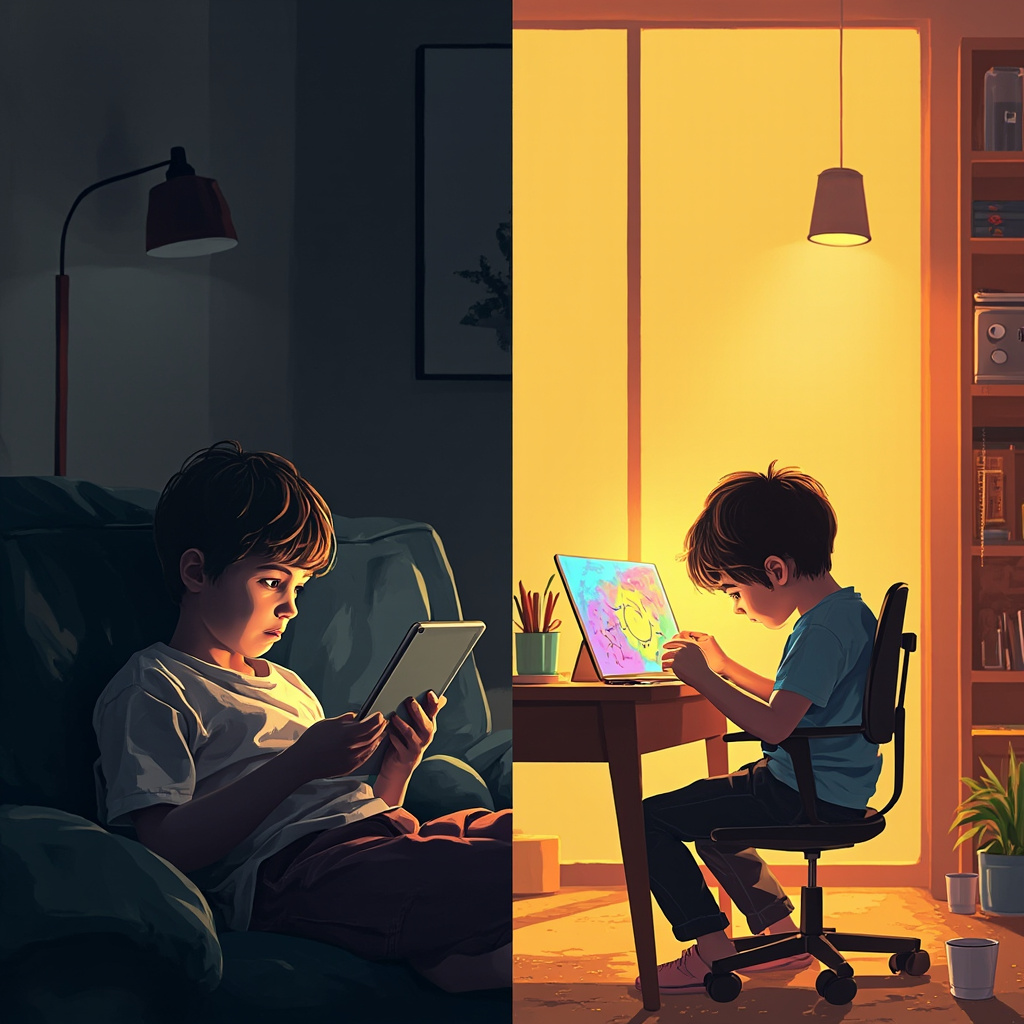
Screen Time: Consumption vs. Creation — Turning Your Child's iPad From a Distraction Into a Development Tool
Screen Time: Consumption vs. Creation — Turning Your Child's iPad From a Distraction Into a Development Tool
The Real Problem with Screen Time — It's Not the Hours, It's the Activity
Let's start with a number that might surprise you: two hours. That's roughly how much screen time the average Thai child logs every day, according to recent studies on digital media use in Southeast Asia. Now here's the more important question — what were those two hours actually spent doing?
Most parents have internalized the "screen time bad" narrative. They worry about timers, feel guilty about tablets, and wrestle with their children over device limits every single day. But here's the truth that rarely gets discussed: the difference between harmful screen time and beneficial screen time has almost nothing to do with the clock. It's about whether your child is consuming content — or creating it.
This isn't a minor distinction. It's the entire conversation.
When we talk about consumption, we're describing passive activities: watching YouTube videos, scrolling through social media, playing games where someone else designed every level, every character, every outcome. Your child sits back and receives.
When we talk about creation, we're describing active building: designing a game, writing code, engineering a robot, composing music, animating a story. Your child becomes the creator.
The first two hours might look identical to a parent standing across the room. But inside your child's brain, these are radically different experiences.
How Consumption-Heavy Screen Time Affects Child Development
Let's be honest with each other: passive screen time feels easy. You need 20 minutes to cook dinner. You pull up a cartoon. Your child goes quiet. Mission accomplished — except that repeated thousands of times across childhood, consumption-heavy screen time actually reshapes how young brains expect to learn and interact.
Here's what's happening neurologically. When children passively consume media — watching fast-paced videos, consuming curated content designed by professionals — their brains enter a receptive mode. They're absorbing, yes, but not doing. The circuits responsible for problem-solving, for persistence, for creative thinking — these don't get strengthened. They get underused.
Developmentally, this shows up in ways that feel disconnected but are actually deeply related. Children who spend most of their screen time in consumption mode tend to have shorter attention spans when facing challenges. They expect solutions to come quickly or not at all. They struggle more with open-ended tasks — the kind that don't have a "next video" button.
There's also a motivation shift that happens gradually. It's not dramatic. It's not something you'll notice on any single afternoon. But over months and years, children who primarily consume begin to associate screens with entertainment and stimulation — not with effort, accomplishment, or self-expression.
The irony? These children often feel bored more quickly, seek more stimulation, watch more content, and loop back around — not because they're "addicted," but because their relationship with technology has been defined entirely by what they can receive from it.
The Power of Creation-Focused Screen Time
Now flip the script. Imagine your child spends those same two hours building a simple animation, programming a robot to navigate a maze, or designing a game with rules they invented themselves.
What changes?
Everything about the cognitive experience shifts. When children create with technology, they enter a problem-solving loop. Something doesn't work. They ask why. They try again. They revise. They persist. This cycle — trial, failure, iteration, success — is exactly the mental framework that fuels academic achievement, resilience, and innovation.
Research consistently shows that creation-based technology use develops what educators call "computational thinking" — the ability to break down complex problems into logical steps, identify patterns, and design systematic solutions. These aren't just skills for future software engineers. They're foundational thinking skills that transfer to mathematics, science, writing, and every subject that requires organized, analytical thought.
There's something else worth noting: children who create with technology develop genuine ownership over their work. That animated story, that coded game, that designed robot — these aren't products they consumed. They're products they built. This sense of ownership builds confidence in ways that passive viewing simply cannot.
And here's a practical observation from educators who work with both types of screen time: children who learn to create with technology tend to become more intentional consumers as well. They develop a deeper appreciation for design, storytelling, and the effort behind the content they watch. The two modes aren't opposites — but creation should come first.
How STEM Advantage Helps Children Use Technology as a Creative Tool
This is exactly why we built STEM Advantage. We created this program because we believe every child with access to a tablet or computer has access to a powerful development tool — they're just not always using it that way.
STEM Advantage teaches children ages 6 to 14 how to create with technology, not just consume it. Through project-based learning in coding, robotics, game design, and digital creation, children learn to see their devices as canvases — not just windows.
What makes our approach different? We start with engagement, not lectures. Children don't sit through long explanations before they start building. They create first, understand principles in context, and develop genuine interest in the "why" behind their tools. This keeps them motivated, active, and developing skills that compound over time.
The curriculum is designed for beginners and growing learners alike. Whether your child has never written a line of code or is already experimenting with design, they find a starting point that challenges them appropriately — and a community that supports their growth.
Our goal isn't to replace consumption with deprivation. It's to shift the balance so creation becomes the primary relationship your child has with technology. The videos they'll still watch, the games they'll still play — these become references and inspirations, not default activities.
Ready to Make the Switch?
Your child's iPad is already in your home. The potential inside it — for learning, growth, and creative development — is already there. What changes everything is how your child is using it.
At Reading Advantage, we're here to help you make that shift. STEM Advantage gives your child the structure, guidance, and projects they need to become creators — not just viewers.
Start your child's journey from passive consumption to active creation today.
Want to talk to our team?
We'd love to answer your questions and help you find the right solution for your child.
Contact UsYou might also like

Math Phobia: The Intergenerational Curse — How Parental Anxiety About Math Is Passed to Children, and How to Break It
How parental anxiety about math is passed to children, and how to break it.
Beyond Doctor or Engineer: EEC's New High-Income Careers
The new high-income careers in the Eastern Economic Corridor (EEC) and how to prepare.
Digital Safety: More than just a Password
Teaching kids to spot deepfakes and AI scams.