The 'Play-Based' Learning Lie: Why Play is Important, but Structure is Essential for Grade 1 Success
The Play-Based Learning Lie: Why Play is Important, but Structure is Essential for Grade 1 Success
The Play-Based Revolution in Thai Preschools
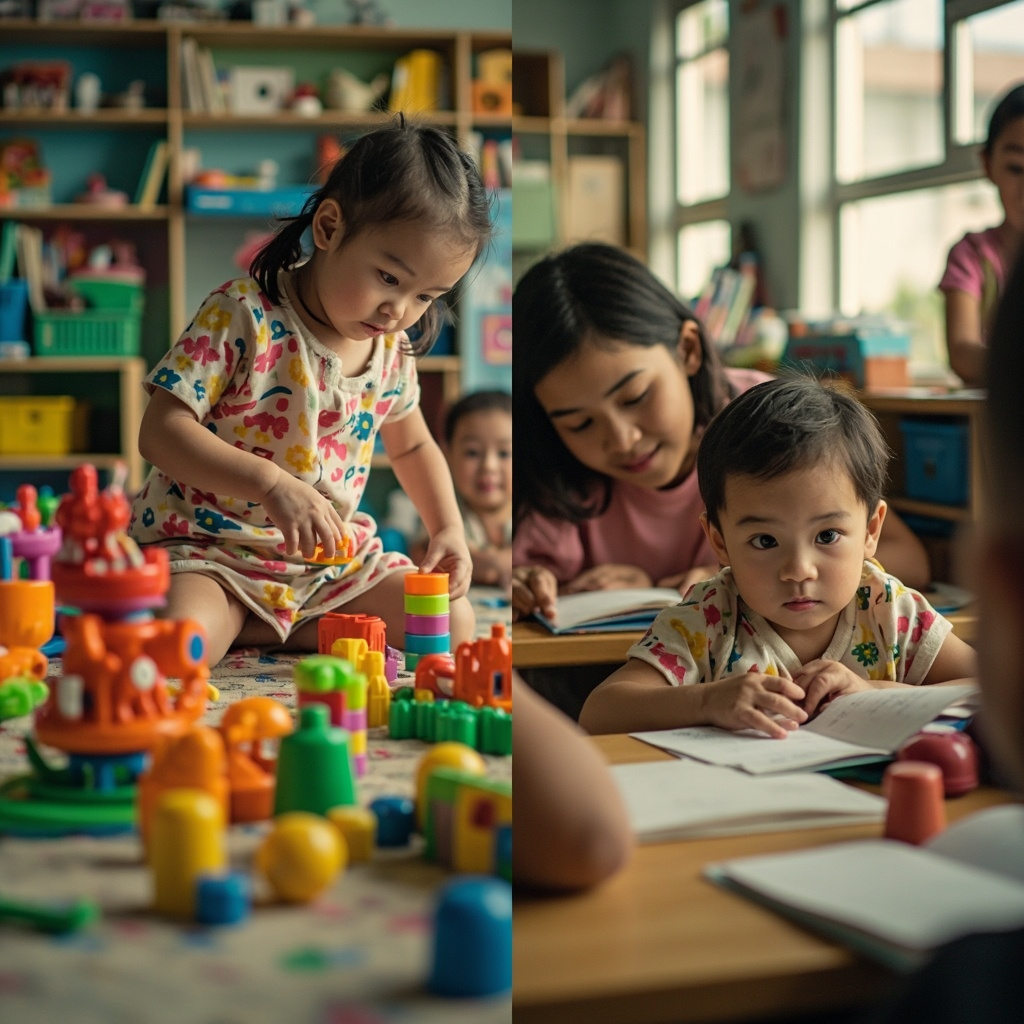
Walk into many Thai preschools today, and you'll notice something striking: classrooms look more like playrooms. Soft blocks, art stations, dress-up corners, and discovery tables dominate the space. Teachers facilitate rather than direct. Children choose their activities. The philosophy is simple—let children learn through play, and they will develop naturally.
This approach, known as play-based learning, has gained tremendous momentum across Thailand. Parents are told that forcing academic structure too early harms creativity. That children learn best when they're having fun. That "school readiness" is a myth invented by anxious parents and profit-driven tutoring centers.
These messages are not entirely wrong. Play is powerful. But the narrative has swung too far—and Thai children are paying the price when they enter Grade 1.
What Play Actually Does for Young Children
To be clear, play-based learning is not harmless. In fact, when implemented well, it delivers genuine benefits.
Cognitive development thrives through play. Children who engage in pretend play demonstrate stronger problem-solving abilities, better memory function, and greater creative thinking. Building towers, playing board games, and navigating imaginary scenarios all challenge young minds in ways that stick.
Social and emotional growth happens naturally in play environments. When children negotiate whose turn it is, collaborate on a project, or navigate a conflict during a game, they develop empathy, patience, and communication skills. These are foundational capabilities that no worksheet can teach.
Independence and agency flourish when children are allowed to direct their own learning. Choosing activities, exploring at their own pace, and experiencing natural consequences all build confidence and self-regulation.
Play, in its many forms, is not the enemy. It is a critical ingredient in early childhood education.
The Hidden Problem: When Play Becomes Insufficient
So where does play-based learning go wrong?
The problem is not play itself. The problem is what happens when play becomes the only approach—and when it lacks intentional scaffolding.
In many Thai preschools, a full-day schedule consists almost entirely of free play, art activities, and discovery centers. There is limited explicit instruction in pre-literacy skills. Children are not systematically introduced to letter recognition, phonetic awareness, or early numeracy concepts. They are not taught to follow structured routines, sustain attention through whole-group instruction, or manage the behavioral expectations of a primary classroom.
The result? Children enter Grade 1 unprepared.
Consider what Grade 1 actually demands: sitting still for extended periods, following multi-step oral instructions, reading and writing basic words, understanding numbers and quantities, managing transitions between activities, and handling a structured schedule with less personal choice.
Children who have only experienced play-centered preschools often struggle with all of this. Not because they lack intelligence or creativity, but because nobody explicitly taught them the skills the classroom requires.
This is the hidden gap. A child can be socially confident, emotionally expressive, and creatively curious—and still arrive at Grade 1 unable to recognize a single letter, hold a pencil correctly, or sit through a twenty-minute lesson.
What Research Says About Early Learning Balance
The educational research is increasingly clear on this point. Studies consistently show that early exposure to literacy and numeracy concepts correlates strongly with later academic performance. Children who begin Grade 1 with foundational reading skills are more likely to become strong readers throughout their schooling.
Cognitive science supports structured approaches as well. Young children's executive function—the ability to focus, plan, and self-regulate—develops most effectively when supported by consistent routines and scaffolded challenges. Play alone does not automatically produce these capacities.
The most compelling evidence comes from programs that blend the best of both worlds. Research comparing purely play-based curricula with structured-but-engaging programs consistently finds that children in balanced environments perform better academically while maintaining comparable social-emotional outcomes. Play does not need to disappear. But play alone is not enough.
What Structured Readiness Actually Looks Like
So what does it mean to prepare a child for Grade 1 success? It means developing specific skills across several domains:
Literacy foundations: Phonemic awareness, letter recognition and formation, vocabulary development, and early comprehension skills. Children should be able to identify letters and their sounds, demonstrate early writing ability, and engage with stories and simple texts.
Numeracy foundations: Counting, number recognition, basic shape and pattern awareness, and early addition and subtraction concepts. Children should enter Grade 1 understanding that numbers represent quantities.
Focus and attention: The ability to sustain attention during teacher-led instruction, follow multi-step directions, and manage distractions in a group setting. Grade 1 requires children to control their impulses and stay engaged for extended periods.
Behavioral and social expectations: Understanding classroom norms like raising hands, waiting for turns, respecting others' space, and following rules. These are learned behaviors, not innate.
Independence and self-management: Managing personal belongings, organizing materials, and handling basic routines without constant adult direction.
These skills are not taught through open-ended play alone. They require intentional instruction, consistent practice, and age-appropriate structure.
How Primary Advantage Delivers the Balance
This is exactly what Primary Advantage is designed to provide.
Primary Advantage is a structured early childhood curriculum that recognizes children learn best when engagement and explicit instruction work together. Our program combines systematic literacy and numeracy instruction with hands-on, play-integrated activities that keep children motivated and curious.
Children in Primary Advantage classrooms develop foundational academic skills through guided lessons, interactive exercises, and meaningful practice. At the same time, they continue to experience the creativity, collaboration, and independence that make learning joyful.
Our daily structure introduces consistent routines that build the focus and self-regulation skills Grade 1 demands. Children learn to transition between activities, manage their attention across different formats, and develop the behavioral independence that serves them in every grade ahead.
The result is a child who enters primary school not just socially ready, but academically confident—able to read, write, reason, and focus, while maintaining the curiosity and resilience that serve them for a lifetime.
Ready to Give Your Child the Right Start?
Play is not the enemy of learning. But unstructured play alone is not sufficient preparation for the demands of Grade 1 and beyond.
Thai parents deserve to understand this balance. Children deserve the advantage of both—curiosity and capability, creativity and competence.
Primary Advantage provides the structured early education foundation your child needs to thrive from their very first day of primary school.
Explore Primary Advantage today at Reading Advantage and give your child the readiness they deserve.
Want to learn more?
Explore how Primary Advantage can help your child.
Learn more about Primary AdvantageWant to talk to our team?
We'd love to answer your questions and help you find the right solution for your child.
Contact UsYou might also like
EP Programs: Is the ROI Worth It?
Research-backed analysis of English Program schools in Thailand: Are they worth the investment?
The Distance Learning Gap: Why Satellite TV Isn't Enough, and the Critical Need for Personalized Feedback
Why satellite TV isn't enough, and the critical need for personalized feedback.

The 'Dek-D' Generation: How Self-Directed Learners Are Bypassing Traditional School Limitations
How self-directed learners are bypassing traditional school limitations.