
Meet Fah: Imagining Vocabulary Practice as an Underwater Survival Adventure
Meet Fah: Imagining Vocabulary Practice as an Underwater Survival Adventure
Some competition entries begin with a small mechanic. Others begin with a whole world.
Fah, a 20-year-old student intern from Khon Kaen Technical College (KKTC), chose the second path. Fah's submission to the Reading Advantage LLM-First Game Competition imagined vocabulary typing as an underwater survival adventure, complete with glowing jellyfish, moving enemies, weapons, upgrades, experience points, and an expanding challenge.
The prototype is called Vocabulary Typing Survivor, and even its opening scene communicates a clear creative direction: learning should feel active, colorful, and full of possibility.
A Memorable First Impression
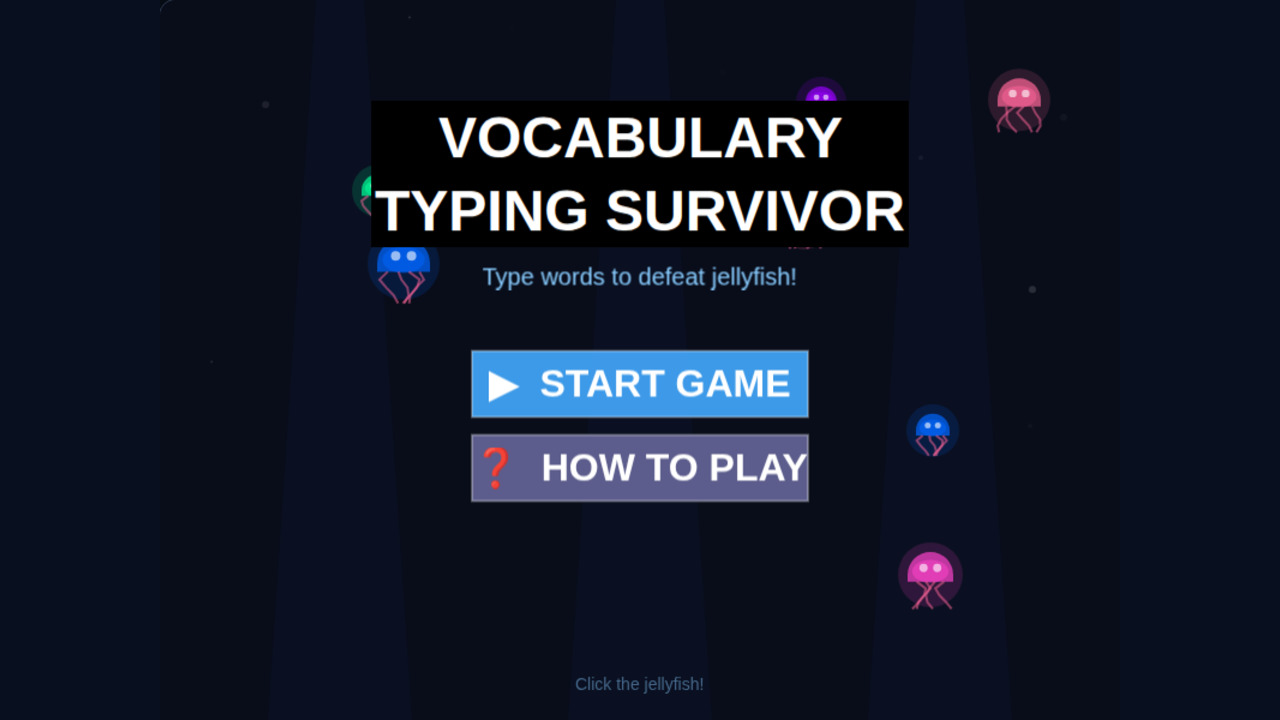
The title screen places the player deep beneath the surface. Dark blue columns suggest rays of light passing through the ocean, while pink, blue, green, and purple jellyfish drift around the menu. Large arcade lettering introduces the game, followed by a simple promise: Type words to defeat jellyfish!
It is an effective piece of visual storytelling. Before the player presses Start, the scene already explains the fantasy, the action, and the playful tone.
Fah created the title-screen jellyfish from code-generated shapes rather than relying on a conventional art pack. Their bright colors, expressive eyes, and moving tentacles give the opening scene a distinctive identity and show close attention to motion.
Thinking Beyond a Single Screen
Vocabulary Typing Survivor was designed as more than one interaction. Fah planned a multi-scene journey with:
- a title screen and how-to-play guide;
- a large world for player movement;
- enemies carrying words to type;
- targeting and typing feedback;
- weapons and automatic attacks;
- experience gems and level progression;
- upgrade choices between rounds;
- a game-over summary and restart flow.
This is ambitious systems thinking for an eight-hour student competition. It shows Fah considering not only what a player does in one moment, but also how a game creates rhythm over time: enter, learn, survive, improve, and try again.
Typing as a Game Mechanic
The central idea connects typing directly to action. Instead of entering words into a separate exercise box, the design associates each enemy with a word. Typing becomes a way to target and attack, turning keyboard accuracy into visible movement and effects on screen.
That concept has exciting educational potential. Every correct character can provide immediate feedback. Completing a word can become a meaningful success. Repeated typing can build both vocabulary familiarity and keyboard confidence while the surrounding game creates a reason to continue practicing.
Fah also explored adaptive ideas such as tracking typing speed, accuracy, and streaks. These systems point toward a learning experience that could respond to the player rather than presenting the same challenge every time.
The Value of a Bold Prototype
A prototype does not need to be a finished commercial game to be valuable. Its purpose is to make an idea visible, test a direction, and show what the creator wants to explore next.
Fah's submission succeeds as a statement of ambition. The project maps out and experiments with scene design, procedural art, animation, physics, input systems, progression, and educational mechanics. Its title screen is the clearest realized entrance to that larger vision, and it captures the personality of the concept immediately.
For a 20-year-old intern, taking on that many interconnected systems is an important learning experience in itself. Building reveals where ideas connect, where complexity grows, and how a strong concept can guide future iteration.
Students as Designers of Learning
Fah's entry demonstrates why Reading Advantage works with interns and students from Khon Kaen Technical College. Young creators bring genres, visual references, and interaction ideas that can make educational technology feel fresh to their own generation.
Vocabulary Typing Survivor asks an inspiring question: what if typing practice felt less like completing an exercise and more like surviving a glowing underwater world?
That question is worth exploring. It reflects the imagination, technical curiosity, and willingness to attempt something difficult that we hope every student carries into the future.
Want to learn more?
Explore how Reading Advantage can help your child.
Learn more about Reading AdvantageWant to talk to our team?
We'd love to answer your questions and help you find the right solution for your child.
Contact UsYou might also like
Meet Copter: Turning English Vocabulary into a Neon Space Battle
How a 20-year-old Khon Kaen Technical College student transformed vocabulary practice into Star Speller 2D, a fast-moving neon space adventure.
Meet Cartoon: Bringing Vocabulary Practice to a Playful Zombie Graveyard
How Cartoon, a 20-year-old Reading Advantage helpdesk team member, designed a lively zombie challenge around Thai clues and English vocabulary.