STEM vs. STEAM: Which One Does Your Child Need?
STEM vs. STEAM: Which One Does Your Child Need?
The Confusion Thai Parents Are Facing
Walk into any international school in Bangkok or flip through the course catalog of a leading Thai tutoring center, and you'll see both acronyms flying around: STEM and STEAM. But here's the question that leaves many Thai parents scratching their heads — what's actually the difference? And more importantly, which approach will set my child up for success in an increasingly competitive world?
You're not alone in feeling confused. The STEM versus STEAM debate has been making waves across global education circles, and Thailand is no exception. Schools are rebranding, ministries are issuing new guidelines, and parents are left wondering if they should be pushing their children toward pure science and math or embracing the creative arts component that STEAM brings to the table.
Let's break it down — clearly, practically, and with the research to back it up.
What Exactly Is STEM?
STEM stands for Science, Technology, Engineering, and Mathematics. This educational framework emerged in the United States during the early 2000s as a response to growing concerns that American students were falling behind in these critical subjects compared to their international peers. The goal was straightforward: integrate these four disciplines to better reflect how they actually work together in the real world.
In a typical STEM lesson, students might tackle a problem like designing a bridge using specific materials, calculating load-bearing capacity, and testing their solution against real-world physics. The emphasis is on logical reasoning, data analysis, and technical problem-solving. Think coding classes, robotics competitions, and hands-on science experiments.
Thailand has embraced STEM education with considerable enthusiasm. The country recognizes that building a strong STEM workforce is essential for its ambitions to move up the economic value chain, transitioning from manufacturing to innovation-driven growth.
Now Enter STEAM: The Creative Evolution
STEAM takes the STEM framework and adds the "A" — Arts. But here's where many people stop reading and assume it means just painting pictures in a science class. The reality is far more sophisticated.
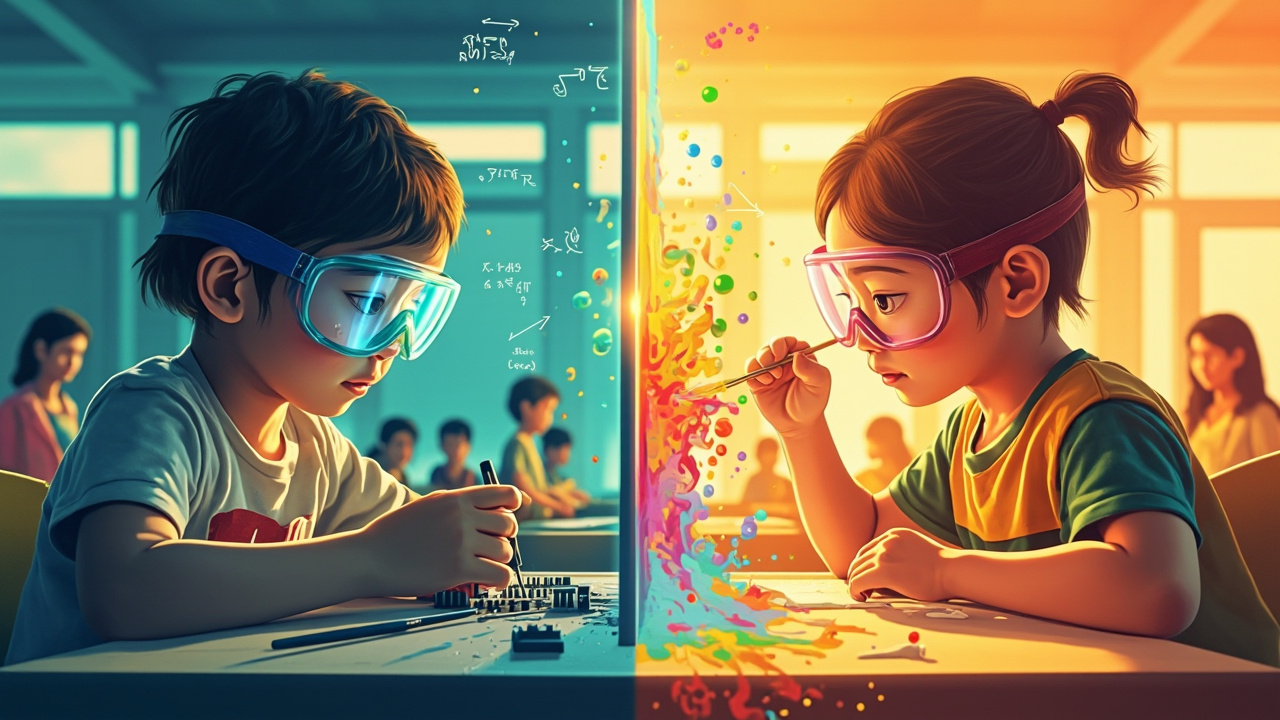
The "A" in STEAM encompasses a broad spectrum: visual arts, design, music, drama, digital media, creative writing, and perhaps most importantly — creative thinking itself. STEAM proponents argue that arts integration doesn't dilute the scientific rigor of STEM. Instead, it amplifies it.
Dr. Georgette Yakman, who pioneered the STEAM education framework, describes it this way: arts provide the context, the human connection, and the creative capacity to make STEM knowledge actually usable and meaningful.
Why the "A" Actually Matters: The Research Speaks
Here's where we move from philosophy to hard evidence. Multiple major research studies have demonstrated that arts integration meaningfully enhances STEM learning outcomes.
SRI International Study: Researchers conducted a comprehensive meta-analysis comparing students who received arts-integrated instruction versus those in traditional STEM programs. The findings were striking: students in STEAM programs demonstrated 23% higher science scores and showed significantly stronger retention of scientific concepts compared to their peers in traditional STEM settings.
Yale Child Study Center Research: A landmark study from Yale revealed that children with sustained arts education showed marked improvements in executive function — the cognitive processes responsible for planning, focusing attention, managing impulses, and multitasking. These are precisely the skills that separate good students from exceptional ones, and good employees from leaders.
UNESCO Creative Economy Reports: The United Nations Educational, Scientific and Cultural Organization has consistently highlighted that creative industries represent the fastest-growing sector of the global economy. Their research indicates that nations cultivating both analytical and creative skills in their workforce position themselves strongly for economic success in the 21st century.
The pattern is clear: arts don't compete with science. They complement and amplify it.
Thailand's Push Toward STEAM Education
The Thai government has not been idle on this front. The Office of the Basic Education Commission (OBEC) has been actively promoting STEAM-oriented curriculum reforms, recognizing that Thailand's future competitiveness depends on young people who can both analyze complex problems AND envision innovative solutions.
The Thailand 4.0 economic model explicitly calls for creative-driven industries and innovation hubs. For your child, this means that understanding STEAM principles isn't just about getting good grades — it's about positioning for careers that may not even exist yet.
National competitions, science fairs, and maker movements are gaining traction across Bangkok, Chiang Mai, and beyond. The message from policymakers is consistent: Thailand needs hybrid thinkers who can bridge the technical and the creative.
Creativity as a Competitive Advantage
So what specific skills does the arts component bring to the table? Stanford University's d.school has been instrumental in researching this question, and their findings point to three critical competencies that arts education uniquely develops:
Design Thinking: This human-centered approach to problem-solving teaches students to empathize with users, define problems clearly, brainstorm multiple solutions without judgment, prototype rapidly, and test iteratively. It's a methodology that combines creative ideation with scientific testing — the best of both worlds.
Visual Communication: The ability to translate complex data and ideas into clear, compelling visual narratives is increasingly valuable in a world drowning in information. Students who can create effective infographics, presentations, and visual stories have a significant advantage in any field.
Cognitive Flexibility: Research consistently shows that arts education trains the brain to switch between different modes of thinking — analytical to creative, individual to collaborative, structured to open-ended. This mental agility proves invaluable when facing novel challenges that don't have obvious solutions.
Why STEM Advantage From Reading Advantage Bridges the Gap
At Reading Advantage, we've watched this debate unfold for years. Here's our conclusion: the question isn't STEM versus STEAM. It's STEM AND STEAM.
STEM Advantage was designed precisely for this moment. Our program doesn't force you to choose between rigorous scientific thinking and creative problem-solving. Instead, we've built a curriculum where these two approaches reinforce each other.
Students in STEM Advantage engage in hands-on engineering challenges that require artistic design sensibilities. They explore mathematical concepts through creative coding projects. They develop scientific presentations that demand visual communication skills. Every module intentionally integrates analytical rigor with creative expression.
We believe — and the research confirms — that the most capable problem-solvers of tomorrow will be those who can move fluidly between the scientific and the artistic, the logical and the intuitive.
Give Your Child the Complete Advantage
The world is complex. The challenges ahead will require more than technical knowledge or creative flair alone. They'll need young people equipped with both — and the wisdom to know when to deploy each.
The choice between STEM and STEAM is ultimately a false one. The question is: which program will give your child the full spectrum of skills they need to thrive?
Explore STEM Advantage — where scientific thinking meets creative problem-solving.
Want to talk to our team?
We'd love to answer your questions and help you find the right solution for your child.
Contact UsYou might also like

EP Programs: Is the ROI Worth It?
Research-backed analysis of English Program schools in Thailand: Are they worth the investment?
The Distance Learning Gap: Why Satellite TV Isn't Enough, and the Critical Need for Personalized Feedback
Why satellite TV isn't enough, and the critical need for personalized feedback.

Math Phobia: The Intergenerational Curse — How Parental Anxiety About Math Is Passed to Children, and How to Break It
How parental anxiety about math is passed to children, and how to break it.