
The Line That Settled the Class
Picture a P5 classroom on Tuesday morning. The comprehension question asks why the girl in the story turns back toward the river.
One answer seems right to half the room. Another answer travels across the desks. A boy in a green polo shirt raises his hand and offers a third.
The teacher does not settle the argument.
"Show me in the story."
Workbooks open. Pages turn. The noise changes. Children stop watching her face and start reading the lines again.
A girl with a ponytail finds the sentence: the girl heard her friend calling from the riverbank. She reads it aloud. Another child reads the sentence before it. The class returns to the question, and the answer now has somewhere to stand.
Not the teacher's authority. Not the loudest voice. Evidence.
The answer belongs to the text
Primary Advantage is foundation-building extensive reading for grades 3 to 6 English. Each printed workbook holds 14 lessons, and every lesson follows the same 13 printed steps.
Step 7 is Comprehension Check. Step 8 is Guided Response. Between those steps sits an important act: returning to the article and examining what it actually says.
This is Data-Driven Consensus, the third pillar of the Big 4 classroom-fidelity protocol. Its principle is direct: "Class answers, not teacher answers. Real-time data, not guesswork."
The teacher guides the discussion. The children bring evidence from the text. Together, they work toward an answer the class can explain.
This also supports a teacher who is unsure of her own English answer. She does not need to perform certainty. She can lean on the text and the class data, then keep the discussion anchored to both.
We are building a live display of how the whole class answered. That display will bring the class's responses into the discussion while the question is still open.
After the bell, one child
The vision continues after the children leave.
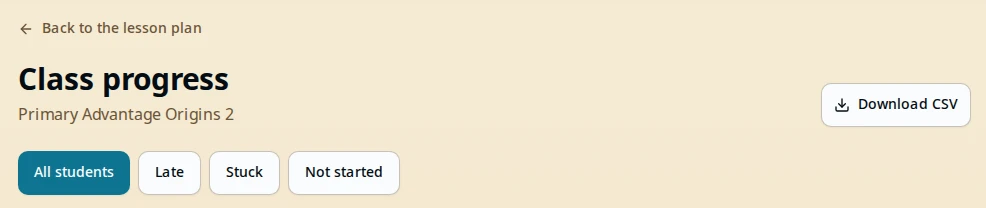
The teacher opens the Primary Advantage class reports. The latest attempt sits beside earlier attempts, so she can look at the lesson without relying on memory.
Her teacher home already puts eight numbers at a glance. It lists open assignments and the students who need help. When she wants a wider view, she can search and sort the class table or export it as CSV.
The next decision becomes specific: revisit one skill with one child.
That is the purpose of the data. It gives her a clear place to begin tomorrow.
A shorter, calmer data talk
Now picture the Tuesday meeting in the school we are building toward.
The head of academic affairs and the teachers look at the same reports. Nobody delivers a long speech about the whole grade. Nobody guesses from one impressive answer in class.
They discuss one child. They choose one skill to revisit. Then they move to the next decision.
The classroom keeps the same discipline. An answer must find its line in the text. A teaching decision must find its evidence in the work.
Data-Driven Consensus connects those two moments. The class learns to explain its answer, and the teacher gains a clearer view of whom to support next.
Short discussion. Open books. One child at a time.
See how a Primary Advantage lesson works: https://www.reading-advantage.com/en/products/primary-advantage
你可能还喜欢

Every Lesson Has a Next Lesson
A parent asks what comes next. A map of skills gives the teacher, the child, and the family a clear answer.

Her Pencil Stops. The Tablet Stays Closed.
A P4 child writes, crosses out, and tries again before the app gives feedback on her own sentence.

She Chooses the Words She Keeps
In a Primary Advantage lesson, a child decides which words and sentences she keeps. The list is hers, and it grows as she reads.